
My research fields are housing and urban economics, labor economics, and household finance.
Working Papers
Revise and Resubmit
Abstract
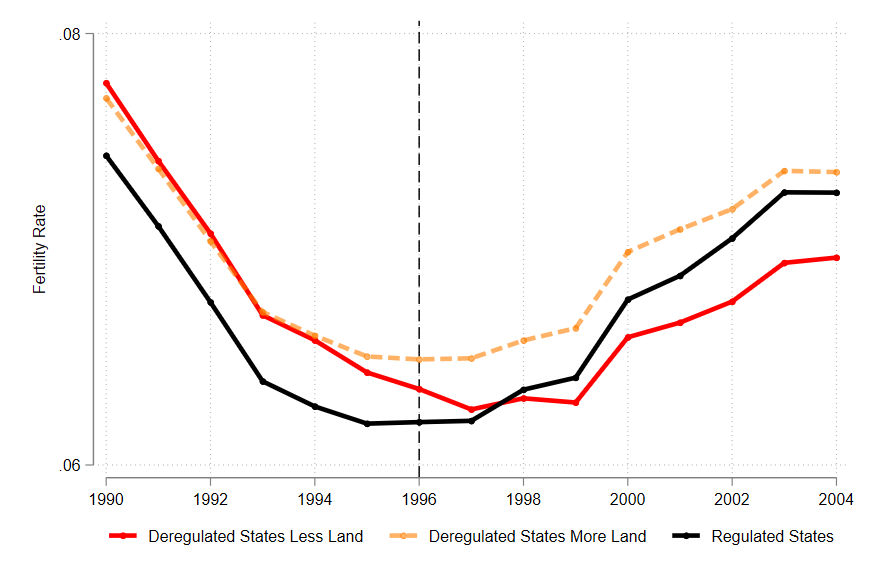
This paper estimates the causal impact of bank credit expansion on fertility by exploiting U.S. interstate banking deregulation in the 1990s. Using the staggered difference-in-differences method, I find that increased credit supply reduces fertility rates by 10 percent and raises maternal age at first birth by 0.76 percent. Further investigation shows that the main mechanism that generates the fertility response is the increase in housing prices from the credit expansion, which is more evident in areas where the housing supply is inelastic. My findings uncover a new channel linking financial market policies to demographic outcomes via housing affordability.
Figure
Abstract
This paper studies the impact of US interstate branching deregulation on school finance and student achievement by exploiting the deregulation as state tax revenue shocks. Leveraging school finance data from universal school districts, our difference-in-differences estimation reveals that deregulation leads to increased per-pupil total revenue and expenditure. The rise in revenue is primarily attributed to higher state revenues, while expenditure increases are more prominent in low-income school districts. Analysis of restricted-use student assessments from the Nation's Report Card shows that deregulation improves student achievement, with no distributional effects evident across students' ability, race, or free lunch status. We introduce an instrumental variables approach that accounts for dynamic treatment effects and estimate that a one-thousand-dollar increase in per-pupil spending leads to a 0.035-0.057 standard deviation improvement in student achievement.
Working Papers
Abstract
This study examines the causal effect of housing wealth on labor supply using restricted geographic data from the Survey of Income and Program Participation. It employs a novel household-level instrument that measures the duration of homeowners' exposure to the housing market boom, driven by credit expansion in supply-inelastic areas, by exploiting household-level variation in home purchase timing. Results show a significant negative relationship between housing wealth and labor supply, particularly for women: a 1 percent increase in housing wealth reduces women's labor force participation by 0.098 percentage points, with no significant effect for men. The effect is strongest among college-educated mothers of young children, underscoring how childcare responsibilities shape this wealth effect.
Abstract
Marriage offers a way for couples to share the costs of investments in household public goods, such as children and household savings. By changing the commitment value of marriage, divorce laws can affect household investments in public goods. This theory, however, is rarely tested in the literature. This study fills the gap by exploring the effect of a legal change in China that altered the property division rule upon divorce, from an equal-division regime to a title-based one. We compared birth rates and household savings of affected and unaffected families before and after the legal change using a difference-in-differences design, and find that title-based property division decreased birth rates. These results are consistent with the theory that title-based property division can reduce the commitment value of marriage and subsequently reduce household investments in public goods.
Abstract
Both the SSI and SNAP programs provide critical assistance in reducing economic insecurity among older nondisabled low-income adults. In this study, we examine how programmatic policy changes affecting SNAP and SNAP-SSI joint receipt of benefits by older nondisabled adults have affected their participation in those programs and, in turn, whether the changes in participation induced by those policies have affected outcomes for material hardship, home and vehicle ownership, and other variables, with particular attention to how the results differ across household asset levels. We find strong effects of several program policies on older nondisabled adult SNAP and SNAP-SSI participation but the effects of different policies differ markedly by a household's level of liquid assets. The increases in program participation resulting from the policies reduce material hardship for all households and lead high-asset households to reduce their holdings of illiquid assets.
Publications
Peer-Reviewed Journal Articles
-
Does Rent Regulation Affect Tenant Unemployment? Evidence from New York City
Journal
Working paper
Abstract
This paper examines the impact of rent regulation on tenants' unemployment in New York City. We provide evidence that rent stabilization increases tenants' unemployment by over five percentage points using data from 2002 and 2017. To address endogeneity concerns, we employ an instrumental variable strategy that exploits the local historical availability of rent-stabilized units when tenants move in as an exogenous source of variation for occupying a rent-stabilized unit. We also develop a job-search model to explain the underlying mechanisms of rent regulation's unemployment effects. Our findings underscore the need for policymakers to consider the unintended consequences of rent regulation.
- Housing Wealth as Precautionary Saving: Evidence from Urban China Journal Working paper
- Human Capital Externalities or Consumption Spillovers? The Effect of High-Skill Human Capital across Low-Skill Labor Markets Journal Working paper
- Land Use Regulations and Urban Growth of African Americans Journal Working paper
- Impact of Land Use Regulation across the Conditional Distribution of Home Prices: An Application of Quantile Regression for Group-Level Treatments Journal
- Property Tax Limits and Female Labor Supply: Evidence from the Housing Boom and Bust Journal Working paper
- Housing Demand and Household Saving in China: Evidence from a Housing Reform Journal Working paper
- Impact of Property Tax Abatement Incentives on Economic Growth Journal
- The Effect of Home Ownership on Post-Unemployment Wages Journal Working paper
- Market Facilitation by Local Government and Firm Efficiency: Evidence from China Journal Working paper
- Environmental Compliance and Firm Performance: Evidence from China Journal Working paper